Showing posts with label Google. Show all posts

Sunday, December 16, 2012

Google No Longer Allows You To Disable Safe-Search:

WEB WORLD MANIA! / WebProNews - Google no longer allows you to disable safe-search:

Google No Longer Allows You to Disable SafeSearch, and That Makes Google Search Worse:

By Josh Wolford

Google has just made their Image search worse in an effort to protect your virgin eyes.

If you’re in the U.S. and trying to search for boobs on Google Images right now, you’re going to have a tougher time. That’s because Google has prevented U.S. users from disabling SafeSearch. And if you want to find NSFW images, you’re going to have to be more specific with your searches.

Google users should be familiar with the SafeSearch toolbar at the top right of Image searches. Until recently, that bar allowed users to select MODERATE, STRICT, or OFF. As of right now, those options have been removed from the drop-down menu – but only in the U.S.

Do you think Google should have messed with the SafeSearch format? Do you think it makes Google Image search worse?

(Read More)

Tuesday, December 4, 2012

Europe vs tech giants: Wants Google, Amazon to pay more taxes:


FIRSTPOST.
TECHNOLOGY

Europe vs tech giants: Wants Google, Amazon to pay more taxes

Paris: A storm is brewing in Europe as nations try to force Internet powerhouses like Google and Amazon to pay more in taxes.
Governments, hungry for money to prop up their struggling economies, are accusing the technology giants of incorporating themselves in low-tax countries so they can avoid paying hundreds of millions of dollars to countries such as Germany, Britain and France — where most of their European income is derived.
In Britain on Monday, a lawmaker pushing to tighten laws said the multinationals’ ability to escape corporate taxes “is outrageous and an insult to British businesses and individuals who pay their fair share.”
According to court documents, French authorities raided Google’s offices in Paris over the summer and seized documents in a tax dispute. More recently, according to a published report, the French government presented Google with a €1.7 billion ($2.18 billion) tax bill; Amazon acknowledged one for $252 million. Facebook is also in the line of fire.

A storm is brewing in Europe as nations try to force Internet powerhouses like Google and Amazon to pay more in taxes. AFP
In Italy, the undersecretary of the Economy Ministry revealed during questioning in parliament on Wednesday that the tax police inspected Google’s books, adding that it found millions in undeclared income and unpaid sales tax.
The politicians are cracking down on US-based multinational companies such as Google, Apple, Facebook and Amazon, claiming they pay paying little or no tax in Europe in spite of generating billions in revenue there.
But there is nothing illegal to the multinationals’ actions. Thanks to the way the European Union is run, companies operating in Europe can base themselves in any of the 27 member countries, allowing them to take advantage of a particular country’s low tax rates.
By setting up overseas headquarters in low-tax jurisdictions such as Ireland or Luxembourg and shifting the profits out of the countries they’ve done business in, the online companies have managed to keep down both sales taxes and corporate income taxes on their overseas income.
Google’s British chief, Matt Brittin, said last week that the company “plays by the rules set by politicians.”
“The only people who really have choices are politicians who set the tax rates,” he told the UK’s Channel 4 News.
The fact that the methods are legal hasn’t stopped resentment brewing among governments, other brick-and-mortar businesses, and households feeling ever higher tax burdens.
The British Parliament’s public accounts committee said Amazon, by accounting for the profits made in the UK elsewhere in the EU, paid 1.8 million pounds ($2.9 million) in British tax in 2011, on revenue of 207 million pounds. In Italy, the government said tax police determined Google had undeclared earnings of €240 million ($311 million) from 2002-2006 and had not paid value added tax of €96 million in the period.
Philippe Marini, the French senator who leads the country’s finance commission, estimated France is missing out on some €1.3 billion in taxes from Google, Apple, Facebook and Amazon. And, Marini noted, that amount would pale in comparison to what they likely owe Germany and Britain where sales figures are even higher.
“A bakery across the street is easier to control,” Marini said. “And households can’t relocate to Ireland just like that.”
The companies say they comply with the law and are cooperative in countries where they operate, but do not elaborate. Even people critical of their tactics say ultimately the job of an accountant is to keep a client’s tax bill as low as possible. The companies also stress that they do pay some taxes – contributions to their employees’ social security, for example.
France, however, is going after the tech companies aggressively: On June 30, tax authorities raided Google’s Paris offices, according to court documents posted online after Google contested the seizure of its files. The tech giant has denied receiving a €1.7 billion bill from the French government and says it pays all legally required taxes.
Taxes fall under French privacy law, so specific amounts are not made public. But the raid on Google’s Paris offices is a sign the French government believes the tech company has more than just incidental support staff in the French capital. France’s budget minister, Jerome Cahuzac, said “a certain search engine needs to regularise its situation in France”.
Facebook, Amazon and Apple have come under similar French scrutiny, according to published reports and public filings. Marini said French law is lagging behind, but hopes to catch up. Tech companies differ from, say, a grocery store in that their product is stored on servers and not on a shelf. And unlike a family, the companies can essentially locate — and re-locate — anywhere.
Both Amazon and Google are contesting the French actions, though Cahuzac said he’s confident the government will win in court.
Britain and Germany have joined France in aggressively targeting the tech giants and, officials say, are coordinating against what one official calls “stateless income.”
The G-20 meeting in Mexico earlier this month showed a measure of international support for tightening the rules. The UK. Treasury chief George Osborne and German finance minister Wolfgang Schaeuble called for a common front “to strengthen international standards for corporate tax regimes.”
“Governments have to keep up in the race,” said Marini, the French senator. “Companies have a much faster pace than either national or European law.”
Helping the governments keep tabs on the tech multinationals is the Organisation for Economic Cooperation and Development. Originally set up in 1948 with the aim of stimulating world trade, the OECD now is taking the lead role in fighting tax evasion, said Pascal Saint-Amans, director of the organisation’s Center for Tax Policy since February.
The OECD has established a locked database detailing some of the world’s most sophisticated tax schemes to allow government tax authorities to privately share revenue-shifting schemes they encounter.
The main problem, for Saint-Amans, is that tax havens within Europe such as Ireland and Luxembourg ease the process that allows multinationals to send profits even further offshore to places like Bermuda. That makes it harder for the countries with the most staff and sales to track. Google, Apple, Microsoft and Facebook have international headquarters in Ireland; Amazon’s international offices are in Luxembourg. But the biggest European markets for all those companies are Germany, France and Great Britain.
“At some point again you’re back to the basics, which is where is the real activity? And that’s something that we may have lost sight of,” said Saint-Amans. “The low-tax regimes are more the consequence than the problem.”
Saint-Amans, who previously worked on ending bank secrecy regulations, believes the problem of taxing “intangibles” can be similarly resolved in a year or two with a concerted effort from all the governments involved, including in the US. In the short-term, he said, the coordinated approach of France, Germany and Britain serves as a warning to multinationals trying to avoid taxes, as is the secure OECD database.
Governments, including in the US, have long tinkered with effective tax rates in order to attract and keep businesses. But there are signs of change even in the US, where all the major tech companies got their start.
“The ability not to pay tax on income that’s booked offshore is now the single biggest corporate tax loophole in the code,” said Reuven Avi-Yonah, an international tax expert at the University of Michigan who has testified before Congress.
The amounts booked offshore are considerable: For Apple, 61 percent of revenues come from outside the US — and fully a quarter of that from Europe alone. “Apple doesn’t have a single store in Ireland,” Avi-Yonah said.
In a filing to the US Securities and Exchange Commission, Apple said it had set aside $713 million for its 2012 foreign tax bill on overseas pretax earnings of $36.8 billion — a provision of almost 2 percent of what it made.
Google’s overseas revenues accounted for 54 percent of its total, including more than 10 percent in Britain alone. Meanwhile Google is tackling government action on another front. German politicians are considering imposing a so-called Google Tax — a levy that would require search engines to pay each time they link to media content like newspaper articles or photographs.
According to a Senate committee memo from September, Microsoft used aggressive asset shifting to avoid $4.5 billion in American taxes from 2009 to 2011.
Avi-Yonah estimated the effective tax rate on overseas income at around 2 or 3 percent for multinational tech companies: Both in the US and abroad, he said, “there’s a general sense that these companies pay too little and don’t really contribute their fair share.”
AP

Monday, December 3, 2012

Google, Tech Companies Take Action to Preserve Internet at U.N. Treaty Talks:


Google, Tech Companies Take Action to Preserve Internet at U.N. Treaty Talks:


A veritable who's who of Internet and tech companies including Google, Facebook, Microsoft, Amazon, Intel, Cisco, AT&T and Verizon are headed to Dubai next week in an effort to preserve a free and open Internet.
Prompting the trip is alarm that proposed updates to a 24-year-old international treaty governing global telephone exchanges and other communications could put control of the Web into the hands of the United Nations and its member states. This could allow some governments to censor speech, cut off Internet access or set new fees for Internet traffic.


Google alone is sending four represenatives to Dubai, more than any other company, as part of a 100-member U.S. delegation of government organizations and officials for the two-week World Conference on International Communications. ...

Monday, November 26, 2012

Is Google a Monopoly and Does It Matter?


Is Google a Monopoly and Does It Matter?

avatar


Break out your history books, folks. It’s time to take a look at monopolies and how the definition may apply to Google’s dominance of the Web in recent years. Sound like dry subject matter to you? It’s not really, if you consider the obscene implications the past may have in relation to the future of the Internet.

A Brief History of US Trusts and Monopolies
Is the history lesson really necessary? Well, yes, if you want to truly understand how to answer the question posed by this article. Never fear – I’ll keep things seriously brief.
A monopoly is essentially capitalism on steroids. The hallmark of a monopoly is a virtual lack of competition. This lack of competition typically leads the monopoly in question to set higher prices, given that there’s no market forces to keep it in check. Inferior products can also result from the lack of competition – and the public will still purchase them if for no other reason than a lack of options.
Here’s the idea of an old school trust: it’s an arrangement between several investors who hold stock in different companies. The stockholders transfer their shares to one combined set of trustees. The reward for their contribution comes in the form of a certificate entitling them to a specified share of the jointly managed companies’ consolidated earnings. Since trusts dominated many of the biggest US industries in the late 1800s, they were effectively monopolies in each of their respective economic areas.
After the Standard Oil Trust formed in 1882, the company and its affiliates had control of greater than 90% of oil refining and marketing in the United States. Needless to say, this did not sit well with the American people. That’s why Congress passed the Sherman Antitrust Act in 1890. The measure effectively destroyed trusts and monopolies that hampered international and interstate trade. From that point on, the US government had the power to bust open companies that had too much power and break them into smaller pieces.
Fast forward to recent history. Microsoft was the first large-scale tech company to be accused of industry monopolization in the US. In a historic 1998 court case, plaintiffs alleged that Microsoft held an abusive monopolistic power on the personal computer industry.
How?
Well, the issue was centered upon the company’s practice of bundling Internet Explorer with its Windows-based operating system. Plaintiffs accused Microsoft of holding a monopoly on Internet browsers since most consumers used the Internet Explorer software prepackaged with their PCs. The case ended with a settlement and a slap on the wrist for Microsoft.
What’s really interesting here is that Nobel economist Milton Friedman, who has since passed away, commented on the case’s outcome by speculating that the Microsoft decision set what he called a “dangerous precedent” which would lead to greater government regulation of tech – and he thought that would impede progress.
Then along came Google.
Google’s Rise to Power
Google really began taking shape as the company we know it today back in 2000. During that year, the company celebrated a sequence of pivotal events: it announced that it had indexed over one billion pages, it teamed up with Yahoo, and it rolled out its search platform in 15 different languages.
Of course, everything began to snowball from there. Google went onto acquire a large number of companies, and it introduced its AdWords program to generate revenue to sustain its growth. Sustain it did – in fact, by 2011, over 96% of the company’s profits came from AdWords… to the tune of $32.2 billion dollars!
However, Google has had its share of hardships over the past couple of years. Despite record profits, it’s dealt with patent suits numbering in the thousands from competing technology companies. It has battled lawsuits from governments and individuals around the world. It’s had trouble getting Google+ to catch on. It had a leaked earnings report to contend with last month. Nevertheless, Big G has held strong as the most powerful tech company in the world – and it’s growing stronger every day.
Google’s Chokehold: Stifling Innovation?
The strategy for Google’s growth seems to be multifaceted, but the main features include the nurturing and expansion of its AdWords program (its bread and butter) and the acquisition of companies to flesh out its ever-growing patent portfolio (its suit of armor).
Take, for example, the mobile industry. Apple and Google are in a cutthroat battle to the death to snap up as many patents as possible. They’re doing this to protect themselves from lawsuits as they blindly feel their way through the ever-evolving landscape of mobile development. A total of $20 billion in patent purchases and patent litigation fees was spent across the board if you include all the heavy hitters in the industry.
Why?
The more patents a company has, the more protection it gains for the new intellectual property it creates. Google is always coming out with new products, so it needs all the protection it can get. Defending against lawsuits is one thing, but acquiring companies and patents like gangbusters is quite another. For many, the patent and company acquisition strategies alone are enough of a basis to accuse Google of monopolizing the tech industry – and stifling innovation in the process.
FTC Sets Sights on Google
This is an unprecedented time for governments around the globe. Google is facing pressure from a variety of countries, a possible backlash against the fear that Big G’s monopoly is – quite frankly – taking over the world.
For example, a settlement was finally reached in a recent group of French lawsuits. The suit took issue with Google’s digitization of French books, and the litigation had stretched on for six long years. In the UK this month, the government will begin investigating Google’s alleged tax avoidance. There are many other suits out there – you can find a detailed list of some of the bigger ones here. Google is even being sued by, um, the world, in one case. Guess unchecked global domination makes you one heck of a tasty target.
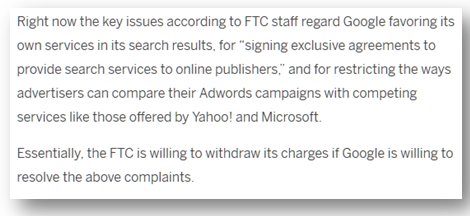
In the US, Google hasn’t had it much easier. U.S. Federal Trade Commission Chairman Jonathan Leibowitz is pressuring Google to make some major concessions in the agency’s antitrust investigation. If it doesn’t take action soon, the company will face an antitrust lawsuit of unprecedented proportions. Here’s the skinny from TheNextWeb:
Image:
So, is Google a monoply?
The FTC lawsuit means that the US government certainly seems to think so. The outcome of the suit will really begin to solidify the argument. Regardless, here’s what is certain: Google is a worldwide, globally dominating force. Many governments are beginning to try to check that power into submission. But Google’s reach is far and its pockets deep. My take? Google can sidestep government intervention all it wants. Amazon, Apple, Microsoft, Facebook, and pals will continue to be the thorn in G’s side – and, quite possibly, the silver bullet of competition that will protect our global, digital society from totalitarian dominance.

Nell Terry is a tech news junkie, fledgling Internet marketer and staff writer for SiteProNews, one of the Web’s foremost webmaster and tech news blogs. She thrives on social media, web design, and uncovering the truth about all the newest marketing fads that pop up all over the ‘net. Find out more about Nell by visiting her online portfolio at Content by Nell.

Join WEB WORLD MANIA! on Twitter:

Monday, November 12, 2012

Do Google’s Quality Raters Really Matter?


SiteProNews

By  in Featured


avatar
Hold onto your virtual horses,Internet. Google’s finally voiced anopinion about its secret army ofquality raters, delivered to you courtesy of Matt Cutts himself. Good news: according to a new Webmaster Help video uploaded to YouTube, their recommendations do not directly affect your website.


Supposedly.
Google’s been mightily “hush-hush” about the role of quality raters and how their opinions affect website positions in the SERPs. That’s why this new video infuses a, much-needed breath of fresh air into an otherwise murky aspect of G’s inner workings.
Oh yeah, and a little leaked info from the quality raters themselves doesn’t hurt, either.
Understanding Google’s Quality Rater
There are thousands of Google raters floating around out there. Too many to count. That’s why Google outsources the hiring and management of these employees to independent firms such as Lionbridge and Leapforce. The raters don’t work directly for Google per se, and things stay much cleaner that way. I’m also assuming that keeping these raters at arm’s length does a good job of protecting G’s trade secrets as well.
If you want to know about pay and working conditions, you can head over to the Google rater section of the WAHM forum. Employees discuss the ins and outs of the program and dish about all the juicy details that the work entails. For example, raters must pass a highly detailed exam before acceptance into the program. They also receive a fair hourly wage, but (this is the important part) they must keep up with a rigorous workload of fast-paced search page analysis.
Upon acceptance into the program, raters are given one of two tasks. In the new video, Cutts goes into detail about the first kind of rater assignment. Raters are typically given two sets of search result pages (a traditional list of ten results) to compare in a side-by-side analysis. Google instructs the raters to indicate whether they prefer the left-hand side of the search results or the right-hand side. Sounds simple, right? Maybe so, but try doing it in volume.
The second task for raters is all about keywords. This assignment falls on the more tedious end of the spectrum. Raters are furnished with a keyword and a URL. They’re charged with assessing the relevance of the given term in relation to the URL’s destination. Keep in mind for this task – they do have the option of marking a specific URL as spam. Remember that – it’ll be important later on.

How Rater Feedback is Weighted
Cutts’ video also clears up some widely held misconceptions about quality raters that have been floating around the ‘net for quite some time now. Cutts first points out that Google instructs evaluation raters (“quality raters”) to judge page quality and rate navigation, among other things.
However, warns Cutts, “Those people don’t influence the algorithm in any direct sense.”
When raters are given the above-mentioned side-by-side analysis task, their opinions do not directly affect the websites in the samples. This is precisely where many people get confused into thinking raters are somehow “penalizing” their websites. It’s simply not so.
When a quality rater indicates he or she doesn’t care for a particular website, that opinion doesn’t cause site to tank. Instead, the aggregate of raters’ opinions becomes data Google uses to tweak the algorithms themselves and not individual websites – see the distinction? With billions upon billions of websites on the ‘net, it makes more sense to use the data to tweak things on a macro level.
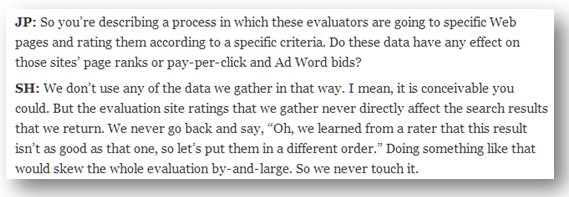
And, for those of you who still have doubts, all this lines up perfectly with a 2009 interview between John Paczowski and Scott Huffman (the Engineering Director at Google).
Here’s a snippet from the exchange:
Image1:
Takeaways
Google has a super-secret book of guidelines for its raters to use while they work. In an act of incredible Internet espionage, some savvy marketers got a hold of the leaked manual and posted the info all over the Web. Unfortunately, Google acted fast to remove the offending material via a series of uber threatening emails. All this scandal makes Cutts’ remark at the end of his video ridiculously exciting – he says that Google may release the coveted rater guidelines to the public at some point in the near future.
One of the most important aspects of the job that raters are talking about in the forum is the speed with which they must complete their assignments. Most remark that reading the rich text snippets listed below each page (as opposed to visiting each website) when comparing search result pages side-by-side is the only way to realistically get through the work volume and keep the gig.
For you, this means that the snippet listed with every one of your ranked pages must be relevant to the query for which you rank. Also, it must be grammatically flawless and highly interesting. Keeping things spam-free will work in your favor as well.
Bottom line: Google raters’ answers won’t directly affect your website’s placement in the SERPs – unless enough of them mark your site as spam.
All this info means, essentially, that Google raters do matter – their macro-level data affects the way algorithms are constructed and altered. On a micro level, however, if your website is not spam, you really have nothing fear. Save all that pent-up anxiety for the next big algo update instead.

Nell Terry is a tech news junkie, fledgling Internet marketer and staff writer for SiteProNews, one of the Web’s foremost webmaster and tech news blogs. She thrives on social media, web design, and uncovering the truth about all the newest marketing fads that pop up all over the ‘net. Find out more about Nell by visiting her online portfolio at Content by Nell.


Join WEB WORLD MANIA! on Twitter:

Monday, November 5, 2012

Google vs. Publishers: Who’s Right?


Google vs. Publishers: Who’s Right?

The story is old, but it is ongoing. It’s the same argument that’s been around for years, but it’s reaching a boiling point, and it’s doing so at a time when the flow of news is coming from more directions than it ever has before. Hurricane Sandy is just the latest in a long line of examples proving that point. Publishers want Google to pay them for the right to point to their content, and Google does not wish to do so.
Should Google have to pay to link to content in Google News? Tell us what you think.
The battle continues in Europe. This week, Google Executive Chairman Eric Schmidt met with French President François Hollande, who according to a report from Bloomberg BusinessWeek(in an article that I did not find by using Google News), “demanded Google reach a deal with publishers”.
Google responded to the French point of view even before Schmidt’s meeting. Here’s what the company said in a blog post a couple weeks ago:
The web has led to an explosion of content creation, by both professional and citizen journalists. So it’s not a secret that we think a law like the one proposed in France and Germany would be very damaging to the internet. We have said so publicly for three years.
Google’s point about the “explosion of content creation” is very valid. Google has been pretty consistent in that it will not pay publishers to link to their content in search results. The question is whether Google users will noticeably suffer if Google stops including content from certain publishers.
This is currently being put to the test in Brazil, where 90% of the country’s newspaper circulation has pulled its content out of Google News. The publishers seem to be getting by fine without Google News (they haven’t pulled out of Google Web Search). The Knight Center for Journalism in the Americas reported that these publishers have only seen a decrease in web traffic of 5%. Isabela Fraga and Natalia Mazotte report:
“The (newspapers) themselves believed that the 5-percent loss was a price worth paying to defend our authors’ rights and our brands,” said Ricardo Pedreira, ANJ’s executive director in a phone interview with the Knight Center for Journalism in the Americas.

“The fact is, Google News is absolutely irrelevant in Brazil,” said Carlos Müller, ANJ’s communications advisor. “If you go into Google News now and search for (Brazil’s) President Dilma, you’re going to see that none of the websites of the main newspapers in the country are there.”

“It’s important to point out,” he added, “that the portals of some news companies are still (in Google News).”

That doesn’t mean, however that publications everywhere could get by as well without Google News. The Bloomberg article quotes Ricardo Pedreira, executive director of Brazil’s National Association of Newspapers, as saying, “Every country has a specific reality, and I think there will probably evolve different models in each nation.”
Google is already facing turbulence in Germany and Italy, in addition to France, so we may very well see publications pulling out of Google News in these countries as Google refuses to pay. Google has made the point in the past, that without said publications, users would be able to find information from other sources.
In September, Google revealed that Google News is currently available in 72 editions in 30 languages, and counts 50,000 publications among its news sources.
“Linking to a diverse set of sources for any given story enabled readers to easily access different perspectives and genres of content,” Google said recounting the product’s history. “By featuring opposing viewpoints in the same display block, people were encouraged to hear arguments on both sides of an issue and gain a more balanced perspective.”
If publishers pull out, they face having their viewpoint lost from users’ view. However, that certainly does not mean that they will not be able to reach audiences via different means, thanks in some part to that explosion of content Google refers to.
Social media has rapidly emerged as a major source of news consumption in recent years. People don’t have to rely on Google News (or search in general) as much as they might have in the past. People have news driven to them via Facebook, Twitter, and numerous other channels all day, every day, right to the phones in their pockets.
In a recent article, I made the case that Google is even risking pushing more news seekers to Twitter specifically thanks to its lack of real time search. Twitter is the place to go if you want to find up to the second updates about anything, like say, a hurricane.
While Google has certainly offered some valuable resources related to Hurricane Sandy, it wasn’t Google that all of the journalism articles were talking about over the past week, with regards to how the news was coming out. There was a lot more talk about Twitter and Instagram (pictures from which were often surfaced via Twitter).
Sure, Google News has continued to serve its general purpose, but the news, as it often does, was breaking on Twitter. Google’s right. There’s an explosion of content, and that’s not going to change. People will find ways to get their news with or without publications in Google News (many of these same publications will be easily found via social media).
So who needs who more? Google or publishers? Google will want to make sure it has enough quality sources in its results, but it is unlikely that they will have to pay many publishers to do so, because thousands simply want to be discoverable in Google, and are happy to be there without demanding fees. Google does have an agreement with the AP for hosted content, and it’s possible that Google could look to plug any potential holes with similar arrangements, but it’s unlikely that Google will submit to such deals with a sizable number of publications. They simply don’t need all of that content that badly. Do they?
Well, I would say no they don’t, to be a useful service. Readers can get by without a lot of the sources currently in Google News. But, on the other hand, losing a significant amount of publications would also be a continued failure at Google’s mission, which is to organize the world’s information and make it universally accessible. It seems that this mission is not worth paying publishers as far as Google is concerned.
What would you do if Google News lost 90% of newspaper publications in your country? Would you miss them? How would you consume your news? How do you consume it now?Let us know in the comments.
 About Chris Crum
Chris Crum has been a part of the WebProNews team and the iEntry Network of B2B Publications since 2003. Follow Chris on Twitter, on StumbleUponon Pinterest and/or on Google: +Chris Crum.


Join WEB WORLD MANIA! on Twitter:

DOJ - Google Joins the AMBER Alert Network:

U.S. Department of Justice

November 5th, 2012 Posted by 

Amber Alert
The following post appears courtesy of Mary Lou Leary, Acting Assistant Attorney General for the Office of Justice Programs

Last week the Office of Justice Programs (OJP) and the National Center for Missing and Exploited Children (NCMEC) welcomed Google into the AMBER alert network.  This innovative and exciting new partnership will provide real-time AMBER Alert updates to users of Google Map and Google Search features.  Because we know a child’s chances for a safe recovery are greater when resources are mobilized quickly, Google Public Alerts will help to ensure a rapid response in the first critical hours after a child goes missing.

As most people know, AMBER alert is a notification system for abducted children.  It began in 1996 in response to the abduction and murder of a nine-year-old girl in Texas named Amber Hagerman.  So AMBER is eponymous, but it’s also an acronym – it stands for America’s Missing: Broadcast Emergency Response. To date, 591 abducted children have been recovered and brought safely home through AMBER Alerts.

AMBER Alert started as a partnership among law enforcement, broadcasters, and transportation agencies and later expanded to include other groups in what we call a “secondary distribution network,” which allows us to target AMBER Alerts to specific areas and to reach citizens directly.   Radio and TV, lottery and highway signs, airports and truck stops, Yahoo, Facebook and AOL, are all part of the AMBER Alert system of getting information about a missing child to people in the very locality in which she was abducted or last seen.  Federal partners such as the FBI, US Marshals Service, ICE and others are part of the team too.  Now Google, through its Crisis Response/Disaster Relief projects becomes another critical ingredient in our mission to keep our children safe.

What’s so exciting – and innovative – about secondary distribution is that it relies on partnerships between public and private entities.  The collaboration with Google builds on that work, and is particularly encouraging in the case of abducted children because we know the safety of our children is an issue we all care about.  Our partnership with Google is a premier example of the great ventures that result when public and private groups pool their resources and ideas.

I have the privilege of serving as the National AMBER Alert Coordinator, and OJP, through our Office of Juvenile Justice and Delinquency Prevention, is the lead federal office responsible for supporting AMBER activities with our public safety partners.  I am tremendously excited about this effort – and about the opportunities this creates for citizens to assist law enforcement in their recovery efforts.   We are deeply grateful to Google for their commitment, to NCMEC for their partnership and for all our work together securing the safety of America’s children.


Join WEB WORLD MANIA! on Twitter:

Sunday, November 4, 2012

Google introduces missing children alerts in US, plans to expand to Canada, Europe:


Google introduces missing children alerts in US, plans to expand to Canada, Europe

Google introduces missing children alerts in US, plans to expand to Canada, Europe
Google is rolling out AMBER Alerts in search results and on Google Maps to highlight areas where children have 
Google introduces missing children alerts in US, plans to expand to Canada, Europe
been abducted to assist US authorities in finding missing children.
These alerts are co-ordinated by the National Centre for Missing and Exploited Children (NCMEC) in the US and come as part of Google’s Public Alerts platform, which delivers a number of emergency alerts to users, such as storm warnings, evacuation notices and other public safety announcements.
Users on both desktop and mobile devices will now see an AMBER Alert icon if they search for information related to a location where such an alert has been issued (ie, where a child was recently abducted). Information on the missing child and other information on the case, such as details on a vehicle involved in the abduction, will also be provided.
Google AMBER Alert test
Screenshot of a test version of an AMBER Alert
It is hoped that increased awareness of abductions will help in the search for these children. Google is also in talks with Missing Children Europe and the Canadian Centre for Child Protection as it plans to expand this service to more countries.


Join WEB WORLD MANIA! on Twitter:

Friday, November 2, 2012

Google Launches Integrated AMBER Alerts:

 TECHCRUNCH


Google Launches Integrated AMBER Alerts Service With The National Center For Missing And Exploited Children

DREW OLANOFF

Wednesday, October 31st, 2012
5935112398_857dcc9163_z
Google has continued its focus on “public service” projects today by announcing a new AMBER alerts project in conjunction with The National Center For Missing And Exploited Children. This comes after the company set up a “Crisis Page” for those affected by Hurricane Sandy. Google is long-known for providing such services, and this new initiative is a fantastic addition.
What will happen is that when you’re using Google Search or Maps, you’ll see an AMBER Alert if one is in your area. AMBER Alerts let you know when a child has become missing and gives you all of the specific details so that you can keep an eye out, or if you’ve already seen something. Facebook already has a system like this, which is equally great.
Here’s what Google had to say about it:
If you’re using Google Search or Maps on desktop and mobile you’ll see an AMBER Alert if you search for related information in a particular location where a child has recently been abducted and an alert was issued. You’ll also see an alert if you conduct a targeted search for the situation. By increasing the availability of these alerts through our services, we hope that more people will assist in the search for children featured in AMBER Alerts and that the rates of safe recovery will rise.
AMBER Alerts will provide information about the abducted child and any other details about the case as they become available. Additional details could include the make and model of the vehicle he/she was abducted in or information about the alleged abductor.
Here’s an example of what you’ll see from the new initiative:
The fact that this is so integrated into Google users’ daily experience is only going to help the association find these missing kids. I would actually love to see more done on the project, basically something that sends your phone alerts or texts as well. Heck, I’d even like to see these alerts in my Google+ stream. Shoot, I wouldn’t mind if these alerts showed up on Google TV, if I had one.
Google said it is also working on bringing the service to Europe and Canada, as well as scaling to more countries. When technology is used for good, everyone in the world wins.


WEB WORLD MANIA

Join WEB WORLD MANIA! on Twitter: