Is Google a Monopoly and Does It Matter?
By Nell Terry

Break out your history books, folks. It’s time to take a look at monopolies and how the definition may apply to Google’s dominance of the Web in recent years. Sound like dry subject matter to you? It’s not really, if you consider the obscene implications the past may have in relation to the future of the Internet.
A Brief History of US Trusts and Monopolies
Is the history lesson really necessary? Well, yes, if you want to truly understand how to answer the question posed by this article. Never fear – I’ll keep things seriously brief.
A monopoly is essentially capitalism on steroids. The hallmark of a monopoly is a virtual lack of competition. This lack of competition typically leads the monopoly in question to set higher prices, given that there’s no market forces to keep it in check. Inferior products can also result from the lack of competition – and the public will still purchase them if for no other reason than a lack of options.
Here’s the idea of an old school trust: it’s an arrangement between several investors who hold stock in different companies. The stockholders transfer their shares to one combined set of trustees. The reward for their contribution comes in the form of a certificate entitling them to a specified share of the jointly managed companies’ consolidated earnings. Since trusts dominated many of the biggest US industries in the late 1800s, they were effectively monopolies in each of their respective economic areas.
After the Standard Oil Trust formed in 1882, the company and its affiliates had control of greater than 90% of oil refining and marketing in the United States. Needless to say, this did not sit well with the American people. That’s why Congress passed the Sherman Antitrust Act in 1890. The measure effectively destroyed trusts and monopolies that hampered international and interstate trade. From that point on, the US government had the power to bust open companies that had too much power and break them into smaller pieces.
Fast forward to recent history. Microsoft was the first large-scale tech company to be accused of industry monopolization in the US. In a historic 1998 court case, plaintiffs alleged that Microsoft held an abusive monopolistic power on the personal computer industry.
How?
Well, the issue was centered upon the company’s practice of bundling Internet Explorer with its Windows-based operating system. Plaintiffs accused Microsoft of holding a monopoly on Internet browsers since most consumers used the Internet Explorer software prepackaged with their PCs. The case ended with a settlement and a slap on the wrist for Microsoft.
What’s really interesting here is that Nobel economist Milton Friedman, who has since passed away, commented on the case’s outcome by speculating that the Microsoft decision set what he called a “dangerous precedent” which would lead to greater government regulation of tech – and he thought that would impede progress.
Then along came Google.
Google’s Rise to Power
Google really began taking shape as the company we know it today back in 2000. During that year, the company celebrated a sequence of pivotal events: it announced that it had indexed over one billion pages, it teamed up with Yahoo, and it rolled out its search platform in 15 different languages.
Of course, everything began to snowball from there. Google went onto acquire a large number of companies, and it introduced its AdWords program to generate revenue to sustain its growth. Sustain it did – in fact, by 2011, over 96% of the company’s profits came from AdWords… to the tune of $32.2 billion dollars!
However, Google has had its share of hardships over the past couple of years. Despite record profits, it’s dealt with patent suits numbering in the thousands from competing technology companies. It has battled lawsuits from governments and individuals around the world. It’s had trouble getting Google+ to catch on. It had a leaked earnings report to contend with last month. Nevertheless, Big G has held strong as the most powerful tech company in the world – and it’s growing stronger every day.
Google’s Chokehold: Stifling Innovation?
The strategy for Google’s growth seems to be multifaceted, but the main features include the nurturing and expansion of its AdWords program (its bread and butter) and the acquisition of companies to flesh out its ever-growing patent portfolio (its suit of armor).
Take, for example, the mobile industry. Apple and Google are in a cutthroat battle to the death to snap up as many patents as possible. They’re doing this to protect themselves from lawsuits as they blindly feel their way through the ever-evolving landscape of mobile development. A total of $20 billion in patent purchases and patent litigation fees was spent across the board if you include all the heavy hitters in the industry.
Why?
The more patents a company has, the more protection it gains for the new intellectual property it creates. Google is always coming out with new products, so it needs all the protection it can get. Defending against lawsuits is one thing, but acquiring companies and patents like gangbusters is quite another. For many, the patent and company acquisition strategies alone are enough of a basis to accuse Google of monopolizing the tech industry – and stifling innovation in the process.
FTC Sets Sights on Google
This is an unprecedented time for governments around the globe. Google is facing pressure from a variety of countries, a possible backlash against the fear that Big G’s monopoly is – quite frankly – taking over the world.
For example, a settlement was finally reached in a recent group of French lawsuits. The suit took issue with Google’s digitization of French books, and the litigation had stretched on for six long years. In the UK this month, the government will begin investigating Google’s alleged tax avoidance. There are many other suits out there – you can find a detailed list of some of the bigger ones here. Google is even being sued by, um, the world, in one case. Guess unchecked global domination makes you one heck of a tasty target.
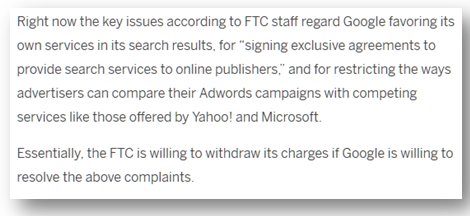
In the US, Google hasn’t had it much easier. U.S. Federal Trade Commission Chairman Jonathan Leibowitz is pressuring Google to make some major concessions in the agency’s antitrust investigation. If it doesn’t take action soon, the company will face an antitrust lawsuit of unprecedented proportions. Here’s the skinny from TheNextWeb:
Image:
So, is Google a monoply?
The FTC lawsuit means that the US government certainly seems to think so. The outcome of the suit will really begin to solidify the argument. Regardless, here’s what is certain: Google is a worldwide, globally dominating force. Many governments are beginning to try to check that power into submission. But Google’s reach is far and its pockets deep. My take? Google can sidestep government intervention all it wants. Amazon, Apple, Microsoft, Facebook, and pals will continue to be the thorn in G’s side – and, quite possibly, the silver bullet of competition that will protect our global, digital society from totalitarian dominance.
Nell Terry is a tech news junkie, fledgling Internet marketer and staff writer for SiteProNews, one of the Web’s foremost webmaster and tech news blogs. She thrives on social media, web design, and uncovering the truth about all the newest marketing fads that pop up all over the ‘net. Find out more about Nell by visiting her online portfolio at Content by Nell.